Welcome to the Healthcare Services Analytics & Decision Science Atlas.
This is a directory of open-source tools, packages, and projects for analytics and decision science in healthcare.
This site is in its very early stages - please check back as we continue to develop it.
In time, we hope this can develop into a tool to help showcase the amazing work happening across the analytics and data science communities in healthcare, promoting reuse and collaborative work on the tools we all need.
Click on the links below, or use the menu bar to navigate.

& Tools
A showcase of projects, code packages, scripts and other resources that may be of use
& Communities
Books, courses, tutorials and communities to help you build your skills
An overview of advanced analytics, operational research and data science techniques and their possible applications
A showcase of graph types of use in healthcare contexts
Search hundreds of recorded conference talks, webinars, workshops and network huddles from across the health and care analytics community, all in one place
Contributions
Contributions are very welcome!
You don’t need to be able to write code or use Quarto to add to the Atlas - there are lots of ways to submit content.
Please see our contributors page for instructions on how to get involved.
Books, Training and Community Resources Documented
Book, Training and Community Entries to be Written
Interested to see what things we propose should be added to the Atlas?
Click on the cards in the right hand column above to see the full list of proposed entries for each type of content.
We’re very grateful to all of our contributors so far!
 Sammi Rosser 💻 🖋 🎨 🤔 🚇 🚧 👀 |
 Amy Heather 💻 🖋 📖 🎨 🚧 |
 Zella King 🐛 |
 padawan 🖋 |
 ReyTan8 🖋 |
Please note that inclusion of a tool on this site does not imply that the HSMA team, NIHR, or any other Atlas contributors, have reviewed these tools in detail. This resource is designed to act as a signpost to the work that is out there, and provide a high-level indication of the health of any given project, but you should always conduct your own reviews of the suitability of any of these tools and techniques for your own use case.
Inclusion of a tool on this page also does not indicate endorsement of the tool author of the HSMA programme, NIHR, the Atlas, or the description written of the tool.
If you have any concerns, or would like any content to be removed, please raise an issue on the repository.
Most Recently Added or Updated Projects, Packages and Tools
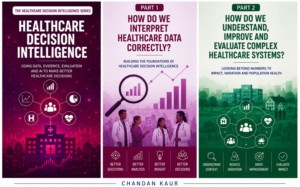
Healthcare Decision Intelligence is a free eBook series helping analysts, clinicians, managers and decision-makers to interpret, question and use healthcare data responsibly. Grounded in realistic NHS scenarios, its modules cover topics such as rates, variation, fair comparison, reading dashboards, evaluation, uncertainty, demand and capacity, data quality, health economics and population health management, each with questions decision-makers should ask. It is accompanied by an interactive companion app that recommends what to read next.
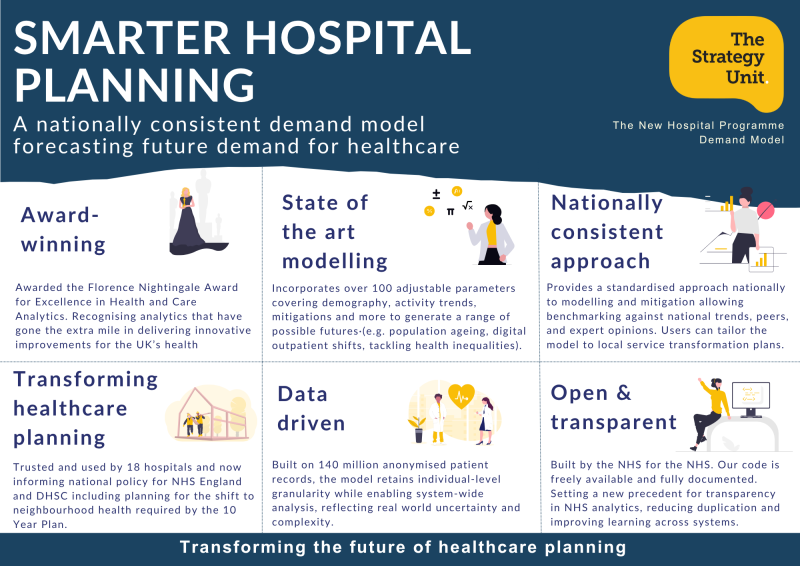
The Demand and Capacity Modelling Tool, developed by the Strategy Unit for DHSC and its partners, supports robust and transparent forecasting of future hospital activity to inform the design and scaling of over 40 new hospitals planned by 2030.
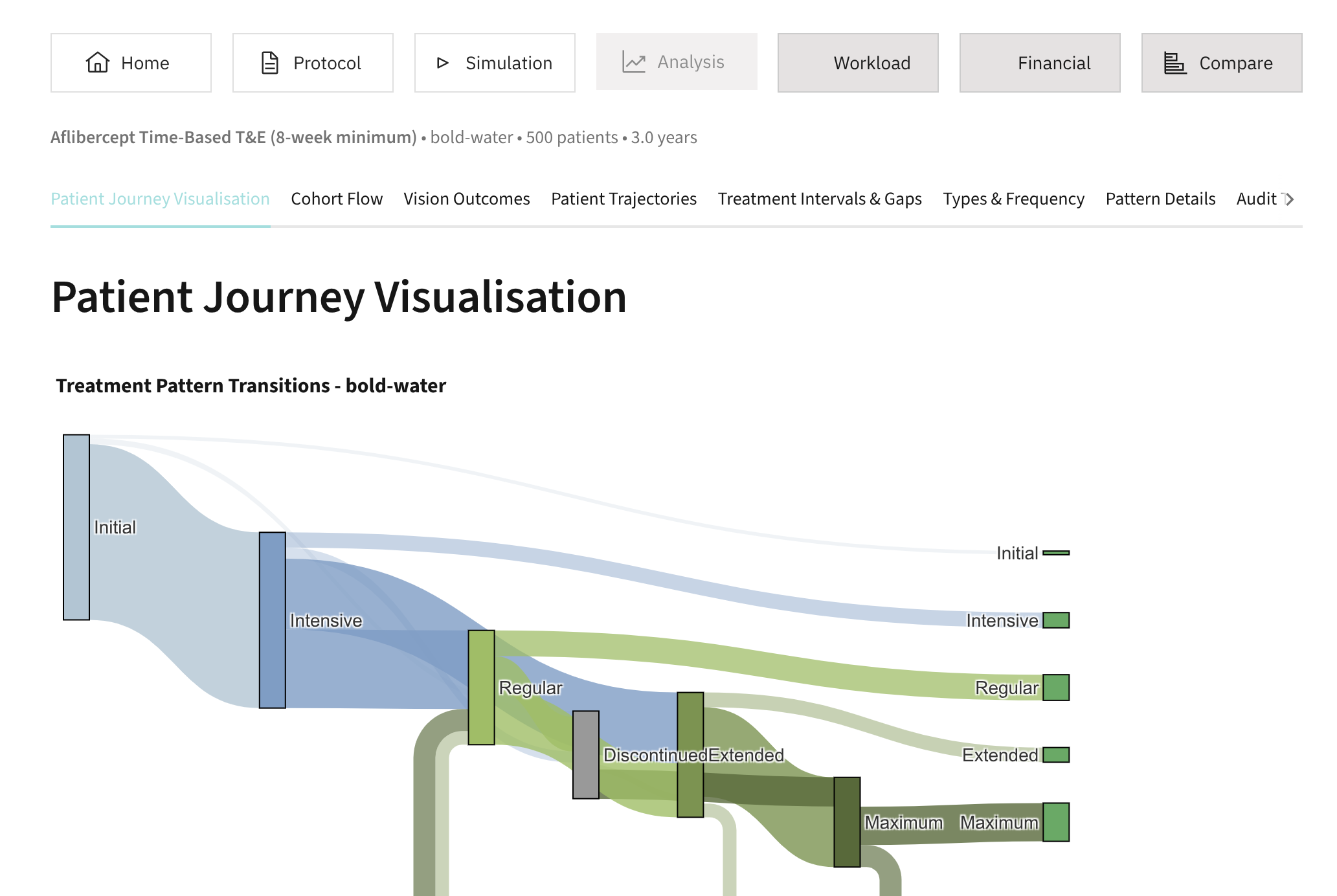
DES of opthalmology pathways, allowing the exploration of the impact of different anti-VEGF treatment strategies on patients and costs.
R package (built using C++ and Rcpp) implementing the definition of 'avoidable' emergency department attendances, as per the School of Health and Related Research at the University of Sheffield's definition, with reference to NHS Digital's SNOMED/HES coding.
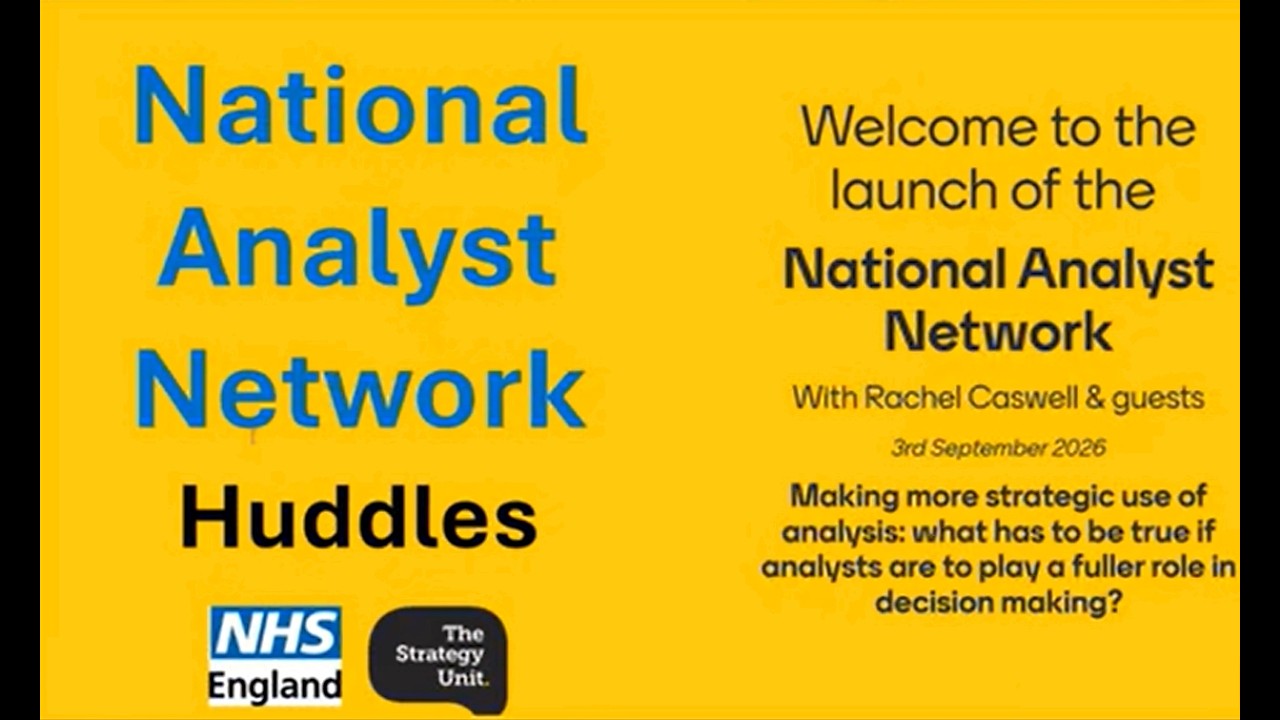
Recordings of the fortnightly online Huddles of the Midlands Analyst Network, hosted by the Strategy Unit, which relaunched as the National Analyst Network in 2026. Each hour-long Huddle features a presenter from health and care, academia or beyond, on topics ranging from health inequalities, waiting lists and demand modelling to data visualisation, RAP and the analyst profession.
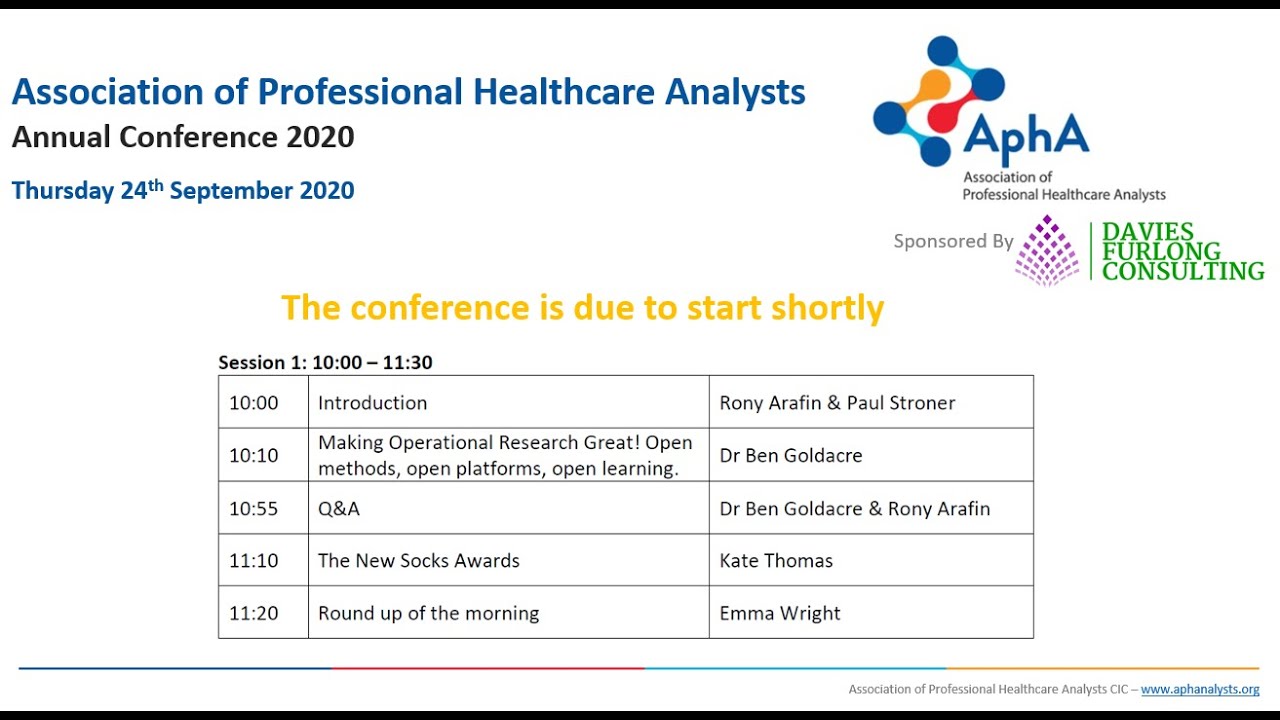
Recordings from the Association of Professional Healthcare Analysts (AphA), the professional body for health and care data and analytics professionals in the UK. They include its regular Lunch & Learn webinars, branch meetings, workshops, and its 2020 and 2021 annual conferences, covering topics from statistics, data visualisation and data storytelling to AI, data platforms and the analytical workforce.
Click here to view all projects, packages and tools.